P.A.S.

There was a hint hidden in the P.A.S. clue that only one of you picked up on. The periods between the initials suggested we were likely dealing with a name.

That name?

Peggy Ann Snow.

Who?

From the opening of the new book:

This volume is named after one of my favorite characters in film: Peggy Ann Snow, played by Ann-Margret in the 1978 psychological horror film Magic. The movie contains one of the best—and possibly only—depictions of the peculiar power of one-on-one magic. And Peggy Ann is more or less my ideal person to perform for: engaged, animated, open to the experience, and, crucially, Ann-Margret.

In the movie, Anthony Hopkins plays a ventriloquist and magician who ends up sleeping with an old flame after she falls for him following a particularly intense Do As I Do card trick.

That’s not a joke. That’s something that really happened in a mainstream Hollywood movie.

He does this while his puppet sits impotently in the other room.

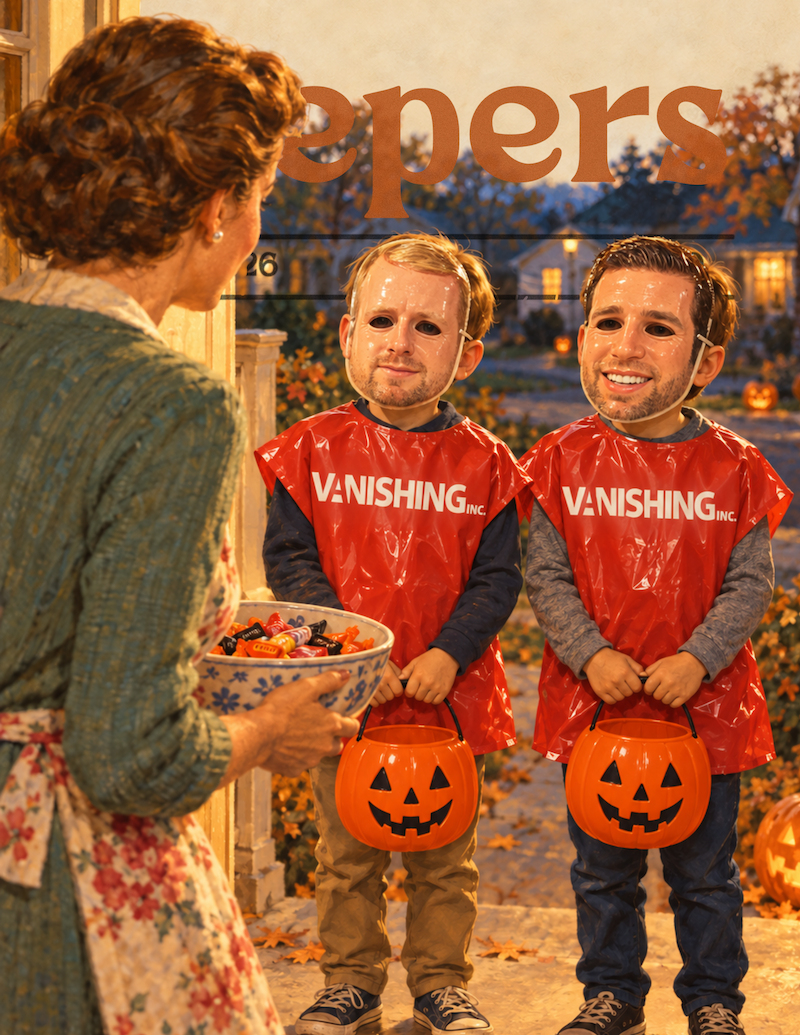
The cover of the new book (illustrated as always by our friend Stasia) is a nod to this scene and the seductive potential of amateur magic—figuratively and, apparently, quite literally.

But it presupposes an alternate version of the story where she ends up fucking the puppet instead.

And it’s Anthony Hopkins’ character in the cuck chair outside.

Jerx Publishing History

During the June Check-In thread, I dropped the news that the subtitle of the next book was P.A.S. and instituted a contest for anyone who could guess what it stood for. I knew it wouldn’t be easy, but I wasn’t prepared for how bad some of the guesses would be.

Palms And Shifts?

Seriously, guys? What blog are you reading? I barely like describing sleights when I have to in the books. If someone told me I had to write an entire book about palms and shifts—200-something pages of me telling you exactly where to put your fingers—I’d put the first phalange of my index finger on the trigger of a gun and blow my brains out.

Tomorrow is the P.A.S. name and cover reveal. But first, as 2026 represents 10 years of writing books for supporters of the site, here are all the previous releases.

The Jerx, Volume 1 (2016)

The Amateur At the Kitchen Table (2016, hardcover reprint 2024)

Magic for Young Lovers (2018)

Thinking of You (2019)

Here Be Bunnies (2020)

White Wand Chronicles Volume 1: The Entertainer (2021)

WWCV2: Young Girls Are Coming To the Canyon (2023)

WWCV3: Escape (2025)


Staying One-Ahead

I'm rediscovering the power of one-ahead routines in social situations. Do you have a go-to method for handling the switch, numbering or identifying the billets, or just generally handling one-ahead when you're out and about?—HP

The one-ahead principle suffers the indignity of being explained in nearly every beginner magic book, always sandwiched between a trick that requires cutting a trapdoor into an oatmeal container and instructions for turning a length of dowel into a magic wand. Surrounded by company like that, it's easy to file it away as something you're meant to outgrow. I certainly did at one point.

But one-ahead is far more powerful than its humble surroundings suggest. We shouldn’t throw the baby (one-ahead) out with the bathwater (dowel-based magic techniques).

I have a couple of different approaches I use, but I’ll give you the easiest and most universal one.

Billets: I just use small slips of paper. Or, if I’m somewhere that has blank-backed business cards on display, I’ll take a few of those.

Labelling: I don’t bother with any subterfuge that allows me to label each billet #1, #2, #3, or otherwise identify them. The best methods for doing this typically require some prep and working off a stack of business cards—two things I want to avoid. And the versions that don’t require preparation tend to feel more suspicious to me than simply not labelling them.

In fact, I’m not sure labelling makes a ton of sense logically. There’s no real need to know the identity of the billet from the outside. In a sense, they’re already labelled on the inside with the information we were supposedly writing down in the first place. So labelling just highlights the idea that maybe you’re going to try to pass one off as another—which is not something I think you want to plant in the spectator’s mind.

Handling: I don’t do any sleight-based switching either. This is all I do…

I write down the force item on the first slip, fold it into quarters, and ask my friend to put it in their pocket.

I have them name the first item.

I write that down on the second slip, fold it into quarters, and have them put it in their pocket with the other one.

They name the second item.

I write that down on the third slip, fold it into quarters, and have them put it in their pocket.

Now we go through the force procedure.

I have them pull the slips out of their pocket and dump them into my cupped hands.

Letting them hold on to the slips feels like you’re being extra fair. When really, having them put the slips in their pocket, remove them, and dump them into your hand is a natural way to confuse which slip is which.

I open all of them toward myself.

Then I recap. What did you name first? Lay that one down. Second? Lay that one down. And for the first time, what was the [card you chose, item at your number on the list, word in the book, or whatever]? Pause a beat, then lay down the final one.

This, to me, feels about as straightforward as it gets. There’s no overproving and nothing that feels oddly structured for the sake of making the trick work.

✿✿✿

The mistake people make with the one-ahead structure is treating the force at the end as the price they have to pay to clean everything up. So they’ll do some quick Cross-Cut Force or something just to get it out of the way.

When really, the procedure lives and dies on the strength of the force. I think you should consider a one-ahead structure as a way to build out a really strong force. You might have an incredibly deceptive force, but on its own, it’s over too quickly to really resonate. Making it the finale of a one-ahead routine gives that force the buildup it needs to really register as impossible. But if the force is weak, it can make the method behind the entire routine transparent.

Mailbag #180

Don’t you think that most Magicians categorise laymen as one singular group?

As if, because they are not magicians - they somehow are all the same.

Not all, I guess.

But some over here (bad ones) talk about laymen like they are singular and not the whole entire world.

As if they all have one shared brain.—CR

On some level, it’s understandable to think of “laypeople” as a monolith. Otherwise, there’s almost no way to make any statements about them whatsoever. What they like, what they bring to the table, and what fools them varies so much from person to person that we more or less have to imagine some generic individual—or else we’d spend all our time saying “if.”

If they’re like this. If they think this way. If they’re inquisitive. If they like mind reading. If they play Texas Hold ’Em. Ad infinitum.

So instead we talk about “Laymen” as if they’re some genderless, ageless, raceless, pansexual entity of indeterminate socioeconomic status, interests, and intellect.

Is that a problem? Not really.

Where it becomes an issue—and I think it’s one of the biggest issues we have in magic—is when our generic “layman” is imagined as someone who just so happens to be dumb, uninquisitive, and fully entertained by the most meaningless tricks and the hackiest jokes.

We don’t picture an intelligent, suspicious non-magician who is perfectly willing to write off most of what we do as “just a trick.” We picture some man-child laughing and clapping at everything we do, because that version of the spectator asks the least of us. We don’t have to work very hard to create something genuinely interesting, deceptive, or compelling if we’ve already imagined an audience that’s delighted by anything.

You see this kind of thinking all the time:

“Sure, they can’t examine the coin. But laymen don’t want to examine things as long as your presentation is entertaining.”

Oh, okay. Sure.

This sort of self-serving rationalization is practically the default setting in magic. We imagine the spectator we need in order for our choices to be justified, rather than the spectator we’re actually likely to encounter.

And I think that’s a big part of why magic has a reputation for being for children: because “Layman”—the imaginary spectator so much magic has been designed to fool and entertain—has essentially been modeled after one.


About 25% of the time, when people introduce me in a social situation, even though I'm a whole person with many fascinating qualities, a family and a cool non-magic job... they call out "Chris is a magician." I've always just kinda shook off these moments and either dovetailed into some conversation about the Magic Castle or they end up cornering me about 'that amazing magician they saw once.'

I've been curious how you handle that situation, the cold/unexpected/sudden intro as a magician: 1) are you ready to jump RIGHT into something with that as the easy entry-point? 2) I RARELY am, and in most cases, I'm just too exhausted or not in the mood to do magic at like a kid's birthday party to dads I don't know… so how do you handle the folks' expectations? They just met a magician who... doesn't really seem amped to do magic? It's an odd social magic scenario.

Thanks for considering this question. I think many folks will wonder about your view on this. —CL

It depends. If Person A is introducing me to Person B, and they say, “And he does magic!” and Person B just says, “Oh, neat,” I wouldn’t be inclined to show them anything.

But if someone is expressing genuine interest in magic, there really isn’t a situation where I wouldn’t show them something.

My mindset is that I have this thing in my life that I invest time in learning for the sole purpose of bringing some joy or mystery into people’s lives. To then get coy about showing it to people feels ridiculous to me.

I know the calculus is different if you perform professionally. But it still feels bizarre to me to turn down an opportunity to do something you (theoretically) enjoy for people who want to experience it. But Andy, would Taylor Swift sing a song at some random party just because she was asked? Actually yes. I was at an event where she did just that. The idea that professional performers are wildly reticent to perform unless they’re getting paid is the opposite of what I’ve experienced on numerous occasions when I’ve crossed paths with them through my non-magic work.

Of course, I’m not suggesting you start pulling props the moment the subject of magic comes up, like these “EDC magic” weirdos do. That’s not what people are hoping for. They want something that feels spontaneous and alive—not something that feels like you’ve been waiting all night for someone to activate your pocket full of gimmicks.

My attitude—not what I actually say—in these situations is: “Yes, I have an interest in magic. Oh, you want to see something? Yeah, I don’t know…I don’t really have anything on me. Actually, there’s this one thing I’ve been learning [or reading about] that we could try.”

Now, I think the main reason magicians are inclined to not show people something in this situation is that they don’t know what to do. It’s not that it would be such a burden to perform. It’s more that they can’t think of what to perform, or they don’t feel like they have something really great to show people.

So, logistically, I think it makes sense to craft a repertoire of a dozen tricks for these situations. And then, from that repertoire, maybe identify a single trick that will be your go-to when your mind goes blank and you can’t think of anything else.

Before starting this site, I used to dodge social performance opportunities frequently. But running this site pushed me to perform more. And the more I performed in those situations, the more prepared I felt for them. In my experience, once you're prepared, being asked to perform stops feeling like an imposition and starts feeling more like an opportunity.

Until September...

This is the final post for August. Regular posting resumes Monday, Sept. 7th.

The next issue of Keepers for supporters comes out Sunday, Sept. 6th.

If you’re a Rich Uncle Millionaire-level supporter and you have an ad for issue 9 of Keepers, get it to me by the end of the month.


Landon Stark submits the following routine and writes…

I’m not sure if it’s something your readers would find useful, since it does require purchasing a little bit of tech to pull off. But I figured maybe 10% of them might be crazy enough to actually try it, and those 10% might really like it.

10% is a wild estimate. It’s closer to 1%. Not because the trick is bad, but just because it would be a significant investment of money and energy to make it work. But it’s an interesting read even if you don’t perform it.

(Fair warning: the write-up occasionally slips into that grandiose AI voice that makes everything sound like the closing narration of a Christopher Nolan movie. I know some of you are hyper-sensitive to that sort of thing.)

Check it out here.


UPDATE: SOLD

There is one final copy of Escape! available. For some reason, every time we publish a book, one gets printed upside-down—meaning, the cover is upside-down. Otherwise, it's perfectly fine.

Now, I contend that because there is no text on the cover, there's no real way of knowing that it's upside-down. In fact, I think it's quite possible this is the only book that was printed correctly. All the other ones are upside-down.

I'm making this final copy available. But I don't really ever know what's a fair price for these things because I don't know how much it matters to people. Do they value the cover orientation, or do they just care about the content?

Well, I'm opening bids on this—just send me an email with Escape! bid $__ in the subject line and fill in your bid. On September 1st, I'll notify the highest bidder that the book is theirs.

You will get the copy of the book with a hand-written inscription declaring this to be the SOLE properly printed copy of the book.

Click here to bid.


There’s no more stirring eulogy to a departed master than passing along your own customer testimonial.

“Juan changed magic forever. And speaking of great magicians, here’s what Brenda from Accounting had to say about me.”

Thank you, Eric, for this beautiful tribute. And, tasteful, reminder that you’re available for corporate events


Kevin M. wrote in to tell me about this impromptu seance/divination "tool."

Charlie/Charlie

I'd never heard of it before, but it's a useful reference point. Being able to point to a real practice helps ground your trick in some skewed version of reality.

Apparently this went viral in 2015 and got treated as a real phenomenon by...well, dumb people, let's be honest—a Fijian ministry banned it in schools, teachers got hauled in for questioning over letting kids play it, and a government in Libya blamed it for a string of suicides.

You could easily frame a pencil balanced on a bottle (that you move with IT) as the version of Charlie/Charlie you played growing up.

That pre-existing mythology does a lot of work for you. It suggests there's already some strange significance attached to balancing a pencil and watching it rotate—rather than that you started with the method and reverse-engineered a supernatural premise around it.


See you all back here in September.

It’s the heart of fair season around here. So if you’re wandering around a state or county fair and spot someone bouncing from one rickety ride to the next barely inspected death trap while simultaneously going down on two corn dogs at once—that’s me! Come say hi.

Invisible Palm Touches

Here are a couple of small ideas for the Invisible Palm plot.

The first comes from Griffin Watt and it’s a quick and casual way to dump off and set up the final ace that would work with many versions of the effect.


Here's an idea I had as a way to end the Invisible Palm trick.

I don't know that it needs an ending. I think it's a beautiful trick when performed well.

But I think if we looked at the trick as a director or a storywriter, it's easy to see a weakness. The main issue with the trick, as I see it, is that it's more or less the same thing happening over and over and over. There's not much of a build to it. And, in fact, the last "invisible palm" is frequently a less impressive phase, since the deck has been introduced into the equation—which is typically less clean than the previous phases, where there are apparently only four cards involved.

What I'm offering here isn't a modification of the trick itself. It's a button at the end. A "Rep" that goes with a trick where you can apparently absorb items into your palm.

After the trick is complete and the reaction winds down, you say, "It's crazy, because I still have some stuff stuck in the invisible palm from when I first learned it back in high school. Can you feel something hard in my palm?" [Resist the urge to say, "I'll feel something hard in my palm tonight."]

You rub your palm with the thumb of the other hand and extend it to them to feel.

"Sometimes it just gets stuck. Like a sliver." Flex your hand a few times. "I do feel like maybe it's working its way out though."

Give your hand a couple of hard shakes and smack it on the table, dislodging a long-lost coin from your palm.

You know what's happening here. It's the Han Ping Chien style stuff (I believe). After the card trick is over, you grab the coin from your pocket with your left hand. It hides under your right hand as if you invite them to feel your palm.

You then drop it from out of your left hand as your right hand smacks it on the table.

I don't know how deceptive this move is generally, but I've had pretty good reactions to it in this context. I think it's because the coin comes out of nowhere. And I don't mean it "magically" comes out of nowhere. I mean that it's been a card trick this whole time and it ends with a coin, so structurally it comes out of nowhere, giving a nice, abrupt surprise at the end. But also something that's in line with what they've seen story-wise.

The Tell/Show Turn

This is my favorite "Turn" into an effect. As discussed yesterday, the Turn is the point where you transition into a magic trick.

Here are two examples of what this particular Turn looks like.

Example 1

You're having dinner with a friend. They ask if you have any new magic you're working on.

"Yeah, I have this one thing I'm working on. It uses music. So, like you would think of your favorite song. And then there's a little mind game you play that opens up an interesting channel of connection related to music. And... wait, actually maybe I could try it with you."

Example 2

You're hanging with a friend. "Is there a bruise there?" you ask, pointing at the back of your arm. "Damn. It feels like there's one there." You explain that earlier in the day you showed a trick to a co-worker and she got pissed and punched you in the arm. [Wagging your finger and imitating her] "You asshole. That's messed up. There's no way you did that. You're messing with my mind." And then she went off and punched me weirdly hard in the arm.

Your friend asks about the trick.

"Oh, it's this thing. It's kind of like a way to manipulate time. You take a dollar and you tear it in half. So now you have a very distinct before-and-after moment to reference. And, so, like you take one half and… actually, why don't I just show it to you."

It's not that you're going to use these specific stories—it's the structure that's important.

You start off describing the trick and then "change your mind" and offer to show it to them.

Why does this work so well? Because before you ever offer to perform, you’ve given them a chance to start wishing you would.

If you walk up to someone and say, "Want to see a trick?" Whether they do or not, that's going to feel a little bit needy on your part.

But here you’re just talking about a trick. That’s much more casual—and much less satisfying. Listening to someone describe a magic trick is a little like listening to someone describe a dream: there’s only so invested you can get in something you’re not actually experiencing.

After a couple of sentences, the natural thought is: I wish I could see this instead of just hearing about it.

Because you’re talking about things like mindreading, time travel, ESP, gambling scams, synchronicity—ideas that would be intriguing to experience. Hearing about them is like hearing someone describe a great new back-rub technique. Okay. But you’d rather feel it.

And that’s the trick of this approach: the desire to see the effect appears in their mind before the offer to perform appears in your mouth.

There’s a second benefit: it makes the performance feel genuinely spontaneous.

Compare pulling a bunch of props from your pockets and asking if someone wants to see a trick with this: you’re talking, the idea of showing them something seems to occur to you in the moment, and now you’re looking around for whatever you need.

“Okay, let’s see. Do I even have the stuff for this? I need a Sharpie, a bill, that little box from the antique store…”

Having to go gather the props can make the whole thing stronger. The lack of preparation becomes evidence that this wasn’t planned.

This is also a helpful Carefree Technique, because it means you don't have to have any props you need on you or nearby. This conversation and the decision to show the other person arose just now—so you can go assemble what you need.

✿✿✿

I know people are going to say, "There's nothing wrong with asking someone if they want to see a trick and then taking stuff out of your pocket."

Here's a thought experiment.

I want you to imagine you meet a quite attractive person of whatever sex you're into. After a few minutes of conversation, they say, "Would you like to see some nudes I had taken recently?"

Even if you’re attracted to this person—and even if you absolutely do want to see the photos—some part of that offer feels a little desperate. They’re pushing something desirable at you instead of giving you a chance to desire it first.

But if the person said, "I just had a modeling gig. It was a new experience for me. I usually do high fashion, but this was just like a necklace and nothing else. I was in a bed and it had these sheets which matched the color of this chunky necklace and the way he had me pose was—well, it's hard to explain—kind of like this…" And as she's talking, you're thinking, "Damn, I'd love to see those photos."

And just as you think that, she says, "Actually, let me show them to you. It's hard to explain and it will be good to get someone else's perspective." She's not going to come off as a sort of sad individual flashing her nudes around. It's almost going to feel like you instigated her offer to show them to you with the way you were thinking.

That's what the Tell/Show Turn is about: creating an unspoken wish in their mind that you are then able to grant by showing them the trick.